
ARE 5.0 PA Exam Guide
Programming & Analysis (PA) is the ARE division about everything that happens before design begins: evaluating the site, applying codes and zoning, and turning client needs into a program. This is the full breakdown of every content area, the exam format, and the question types.
What's actually tested on the PjM exam?
Exam Format and Structure
Pass Rates and Statistics
Exam Duration and Question Types
PjM pass rate: Black Spectacles students pass 39% more often
Black Spectacles testers pass the PA 85% vs the NCARB average of 61%
The national pass rate for Programming & Analysis (PA) sits near 61%. Students who prepare with Black Spectacles pass at roughly 85%, because the prep mirrors the real NCARB exam: full-length practice exams tagged to every content area, expert-led video lectures, quiz breaks inside each lesson, and flashcards tied to key terms.
What the PA Exam Covers
NCARB publishes a target weight for each content area as a percentage of exam items on a typical form; individual forms vary slightly. Read the bars below like a dimension string on a drawing — the longer the run, the more of the exam it occupies.
1. Environmental & Contextual Conditions
2. Codes & Regulations
3. Site Analysis & Programming
4. Building Analysis & Programming
What a PA exam question looks like
Try two sample PA questions, one multiple choice and one check-all-that-apply, then reveal each answer and its full explanation.
An architect is designing an accessible corridor in a new public building. Three different applicable standards regulate the minimum corridor width along the accessible route:
- The local building code requires a minimum width of 44 inches
- ANSI A117.1 requires a minimum width of 48 inches
- The owner’s institutional design standards require a minimum width of 60 inches
Which corridor width should the architect use?
Correct answer: C. 60 inches
When several standards set a minimum, the architect should follow the most restrictive one, which is the largest, so a 60-inch corridor (C) meets the 44-inch local code, the 48-inch ANSI A117.1 requirement, and the owner’s 60-inch standard at the same time. Choices A and B satisfy only some of the standards, and D is wrong because any width under 60 inches would violate the owner’s requirement.
An architect is reviewing the local zoning ordinance before beginning the preliminary design of a new construction office project.
Which of the following zoning requirements could affect the maximum gross area of the project? Check the four that apply.
Correct answers: A, C, D, F
Gross area is the total of all floors measured to the outside face of the exterior walls, so maximum floor area (A) limits it directly, while lot coverage (C), maximum building height (D), and minimum yard setbacks (F) limit the footprint and number of floors that fit on the lot, sometimes more tightly than floor area does. Allowable use regulations (B) govern what type of project can be built, not how big it can be, and off-street parking regulations (E) only affect size indirectly by taking up space.
What the PA practice exam looks like
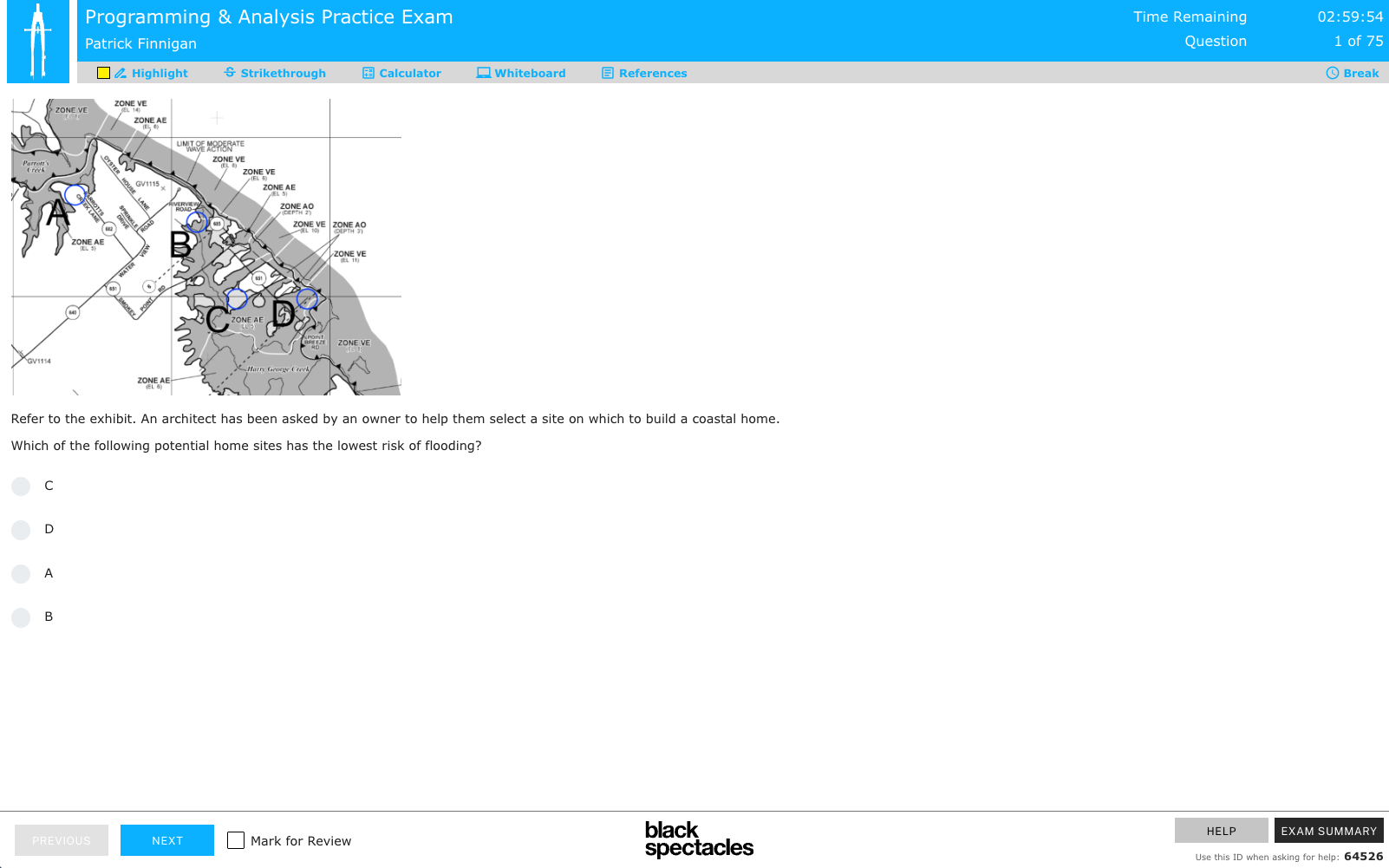
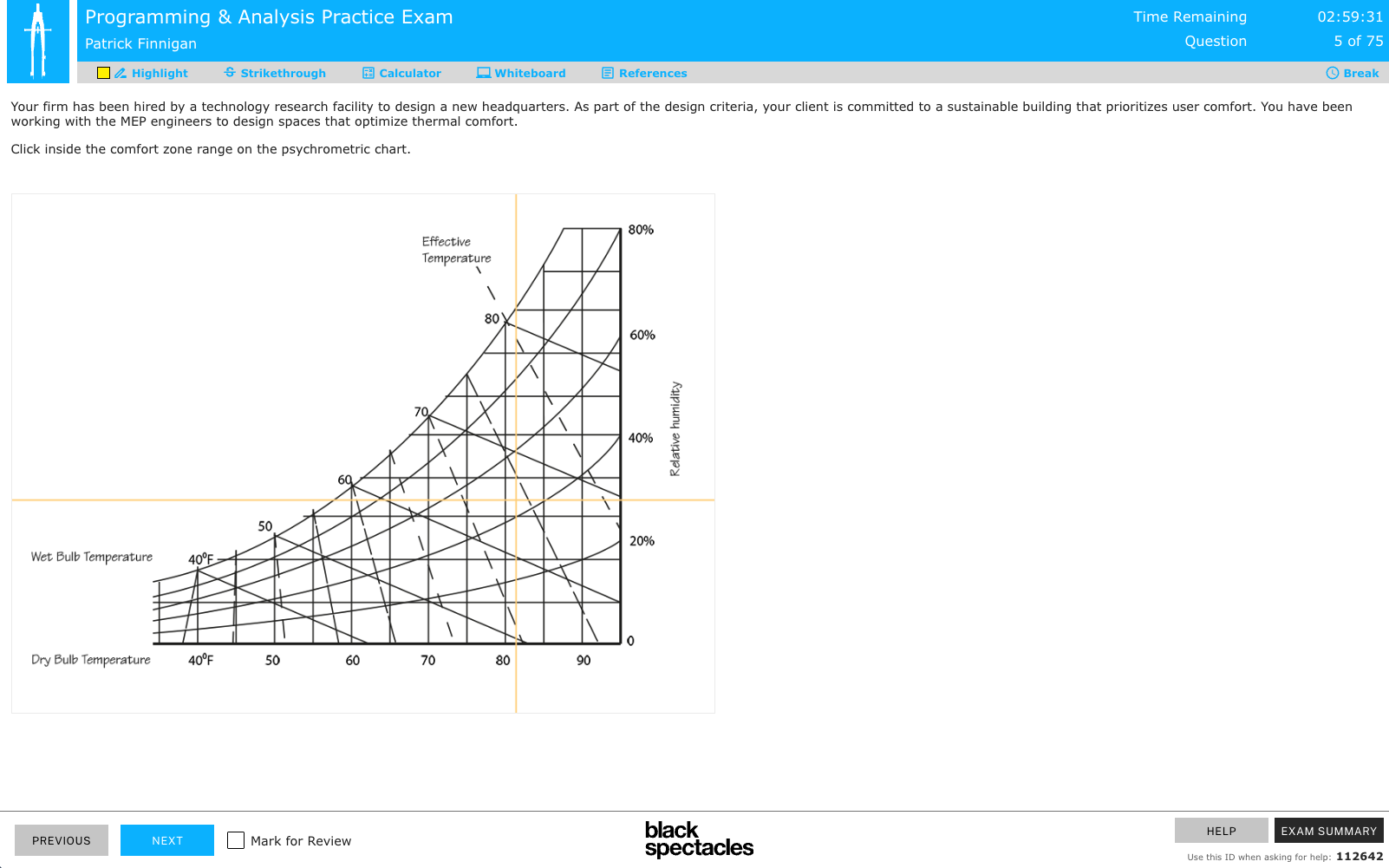
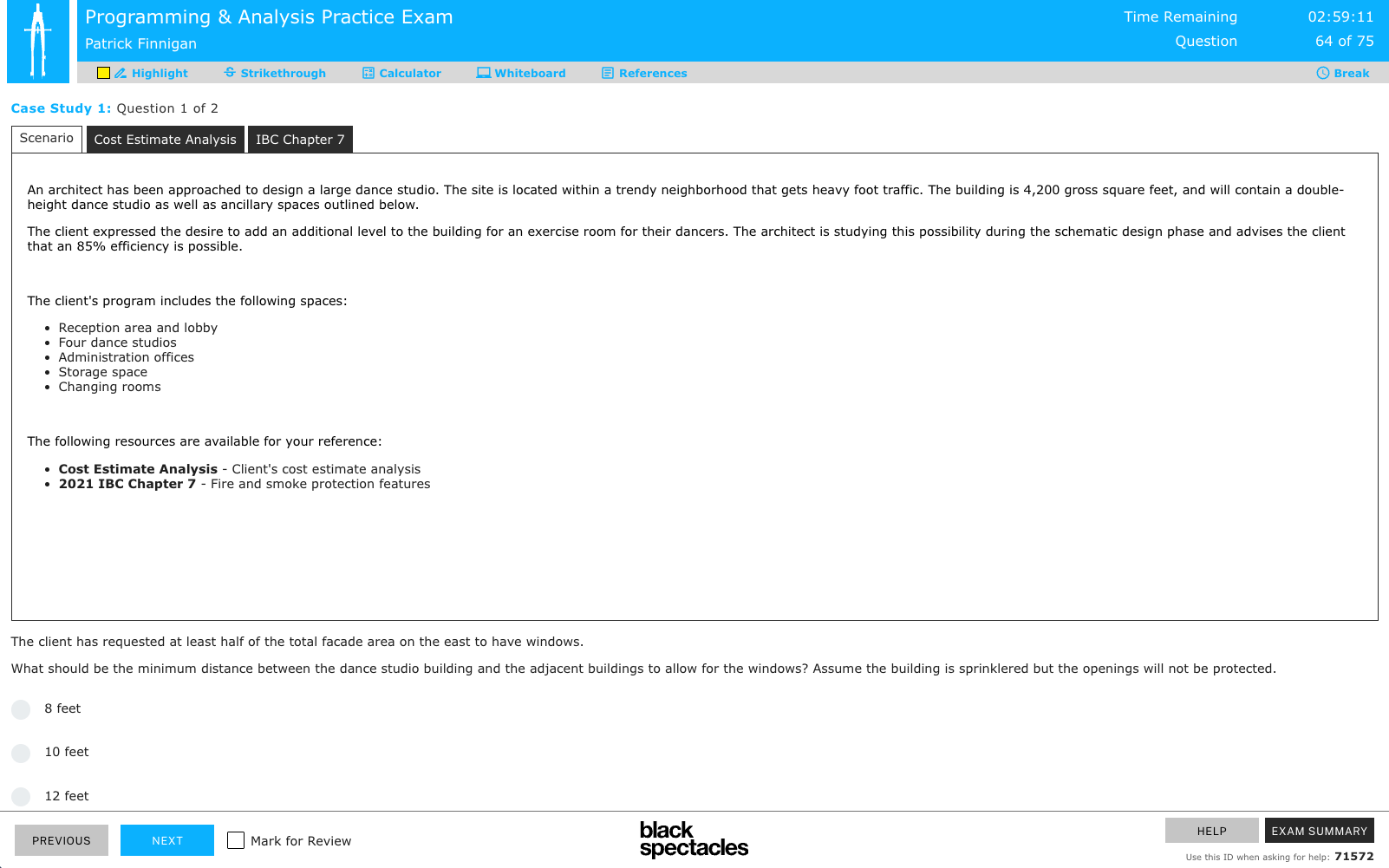
The Black Spectacles PA practice exams mirror NCARB’s interface and question types, so test day feels familiar.
Study materials to help you pass the PA
Black Spectacles pairs the breakdown above with a full set of PA study tools built by licensed architects — so you can move from "what’s tested" to "I’m ready" without guessing.

PA video lectures
Expert-led lessons that break each content area into manageable segments, with quiz breaks built in.
Full-length practice exams
Timed, NCARB-style exams tagged to every PA content area so you can see exactly where to focus.
Digital flashcards
Quick-review decks tied to key PA lecture terms — building analysis, site analysis, codes, and environmental conditions.
Section quizzes
Check your recall after each section and find weak spots before the practice exam stage.
Real-World Practice
Self-paced, NCARB-inspired case studies that apply PA concepts in context.
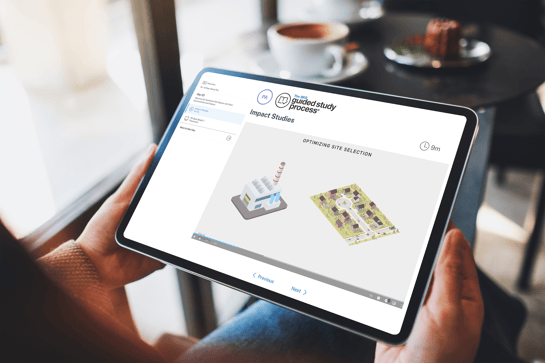
Guided Study Process
A day-by-day plan built around your PA test date — most candidates study 6–8 weeks. Know exactly what and when to study, so you can walk into exam day with confidence.Ready to Pass the PA Exam?
Video lectures, full-length practice exams tagged to every content area, flashcards, quizzes, and a guided study plan built around your exam date — the same system that helps Black Spectacles students pass PA at roughly 85%.
Watch a Licensed Architect Work Through a PA Mock Exam
In ARE Live, a licensed architect works through real PA-style questions and explains the reasoning out loud — the closest thing to sitting beside someone who’s passed.
Watch ARE Live
Free monthly mock exams and study strategies from licensed architects.Instagram · PA TipsQuick ARE concept reels
Bite-size study reminders on site analysis, building analysis, programming, codes, and environmental conditions.Podcast · ARE LiveListen to ARE Live
Mock exam walkthroughs and study strategy episodes, including PA.Study with a community of architects
See how candidates prepared for the ARE, then join the conversation.
“The videos were exactly what I was looking for. Everyone learns differently and this format is perfect for me. If you like a classroom setting with relatively short concise videos breaking down each concept, give this learning platform a try.”Armando L.
“Black Spectacles was great. I passed my first 3 exams on the first try. I love their practice exams, they are set up exactly as the real exam. Reviewing the practice exam results was even more helpful. They explain why the correct answer is right and why the incorrect answers are wrong.”Rahul N.
“I found Black Spectacles the best source for studying ARE 5.0. The videos are very comprehensive and provide a lot of information without overwhelming you. I highly recommend Black Spectacles, it is the best source right now to tackle ARE 5.0”Veronica B.
